

Energy performance rarely deteriorates all at once. It is usually lost in small increments: a fouled heat exchanger, a drifting sensor, a leaking valve, an overloaded motor, a blocked filter, or a generator that no longer carries its intended load efficiently. A maintenance plan makes those losses visible before they become a utility-cost problem or an operating interruption.
Connect maintenance priority to energy consequence
Traditional schedules often rank work by calendar interval or failure risk alone. Add two questions: how much energy does this asset influence, and what happens to the facility when its performance drifts? Chillers, pumps, compressed-air systems, refrigeration, motors, power-factor equipment, controls, and standby generation can deserve earlier attention because their condition affects both cost and continuity.
Build the plan from operating evidence
Use records already available to the team. Combine utility bills, demand peaks, generator fuel and run-hours, maintenance history, alarms, runtime data, temperature or pressure readings, and operator observations. The objective is not to create a perfect database. It is to identify assets whose condition is changing, whose energy signature is unusual, or whose failure would remove an important operating safeguard.
Separate routine work from performance restoration
Routine work keeps an asset available. Performance restoration returns it to an efficient operating condition. A filter change, coil cleaning, control recalibration, belt adjustment, leak repair, motor alignment, or setpoint correction may be a maintenance task, but its result should also be checked against a measurable operating value. Record the before-and-after reading where practical.
Use three planning horizons
- Now: correct safety issues, active leaks, failed controls, abnormal temperatures, severe vibration, and other immediate losses.
- Next quarter: address recurring faults, high-runtime equipment, unexplained energy changes, and maintenance work that protects the next operating season.
- Capital plan: group assets approaching end of useful life, systems with poor parts support, and recurring repairs that may justify replacement or redesign.
Protect resilience, not just efficiency
Resilience depends on systems working together. A well-maintained generator still needs reliable starting batteries, fuel quality, ventilation, transfer switching, load testing, and a clear operating procedure. Pumps need dependable power and controls. Cooling systems need clean heat-transfer surfaces and verified sensors. Maintenance planning should therefore test the whole service path, not only the main asset.
Make the plan useful to management
For each priority item, record the asset, observed condition, energy or operating consequence, required action, owner, target date, expected cost range, and verification method. That short register gives finance, operations, and leadership a common basis for deciding what to repair, monitor, or replace.
Inside the Apex maintenance workbooks
The Preventive Maintenance Planner keeps the asset identity, equipment type, location, installation date, and useful-life assumptions in one working register.

The same record connects service intervals and condition ratings to due dates, overdue status, and the notes the team needs to act.
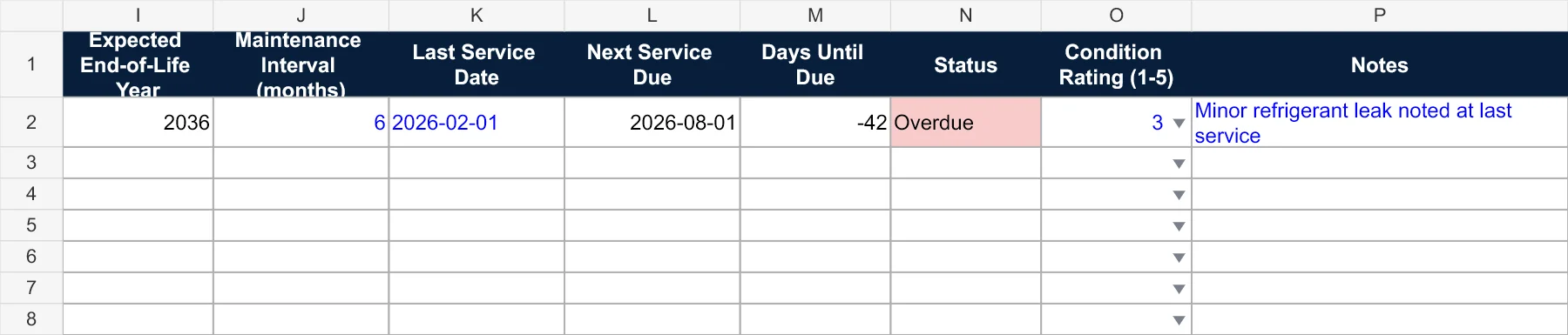
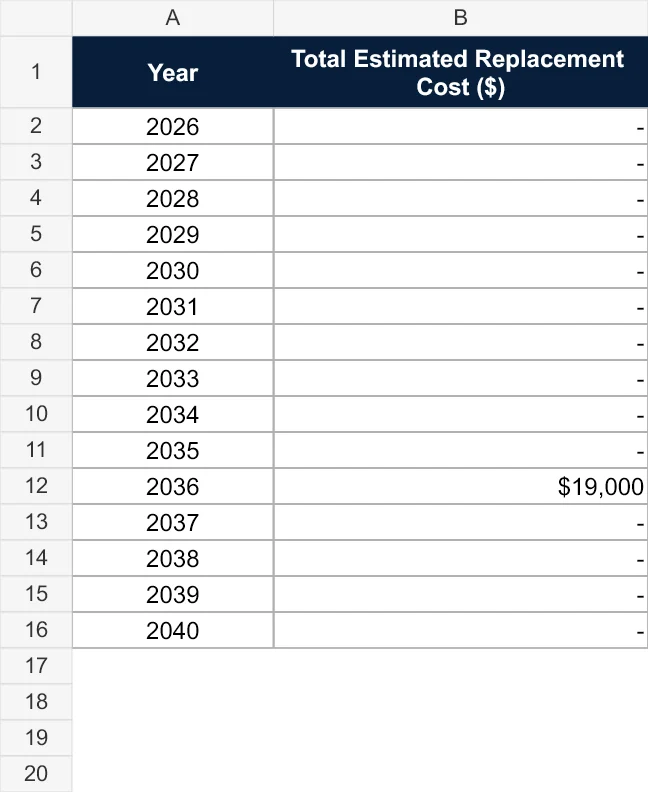
The Capital Replacement Planner then rolls expected end-of-life timing and replacement-cost estimates into a year-by-year forecast.
Select any workbook image to open the full-size preview.
Use the Apex maintenance tool
Turn the priorities above into a consistent asset-risk screen with the Apex Maintenance Risk Planner. It ranks condition, criticality, age, and failure consequence so teams can compare what needs attention first.
Open the Apex Maintenance Risk Planner →
The planner is available in the Premium workspace for accepted Apex members.